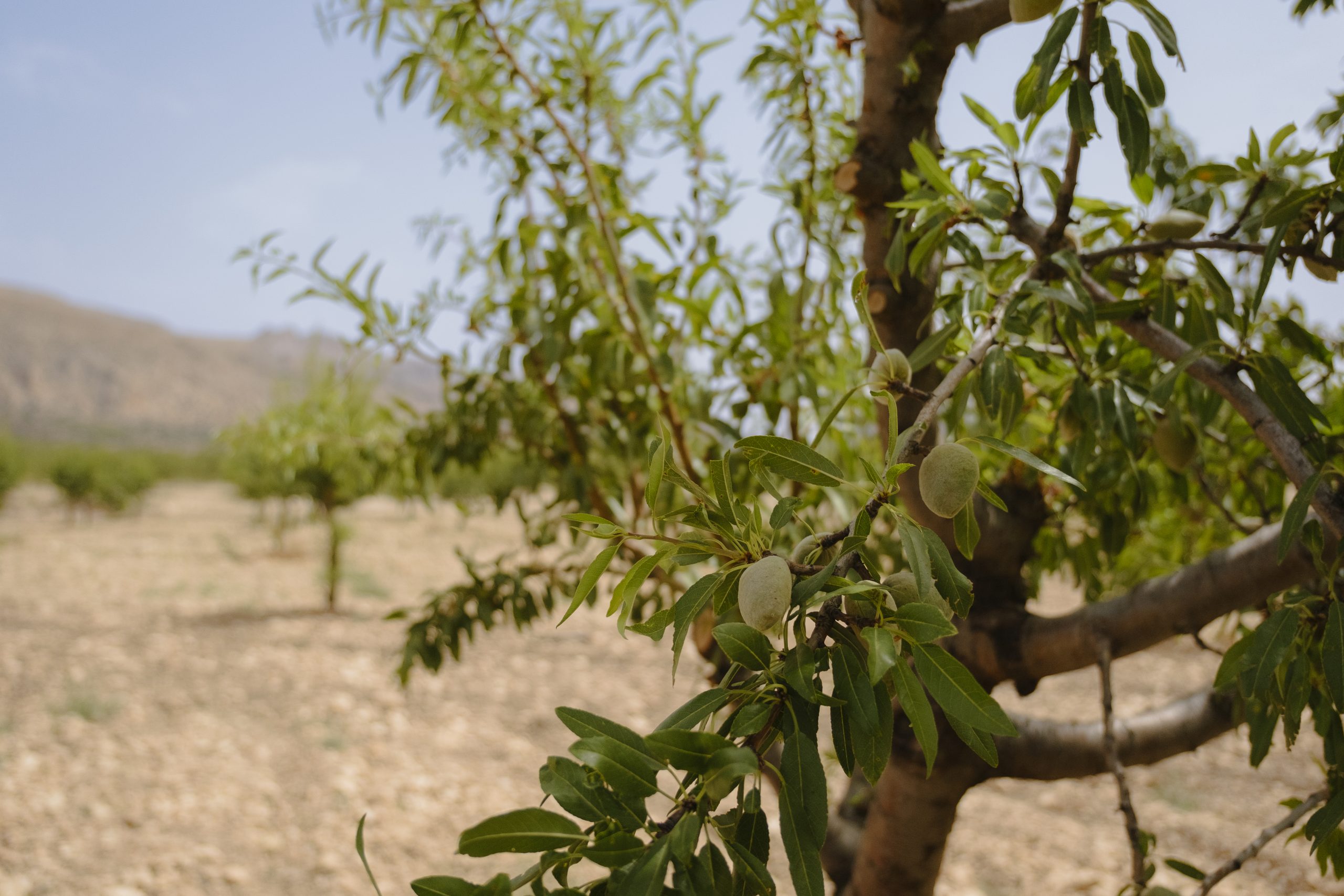
Almonds (Prunus dulcis) have been part of Mediterranean agriculture for centuries. They likely arrived in Europe through trade routes from the Middle East and Persia more than 2,000 years ago, flourishing in dry, sunny regions.Today, Spain is by far the largest European producer, responsible for about 70–80% of the EU’s almond output. They are followed by Italy, Portugal, Greece, and France. The main Spanish regions are Andalusia, Murcia, Valencia and Castilla-La Mancha, where the combination of mild winters and hot, dry summers suits the almond tree perfectly.Most almonds are grown on dry, rocky soils, often on hillsides. These conditions are ideal for rain fed cultivation (the traditional Mediterranean method) which relies almost entirely on natural rainfall.The life cycle of an almond treeAn almond tree starts bearing fruit around its third or fourth year, but only reaches full production after seven to eight years. Once mature, it can produce for up to 40 or 50 years.The cycle begins with blooming in late winter, when pink or white flowers appear before the leaves. Pollination is crucial and typically depends on bees. By spring, the fruit (the almond hull) forms around the shell.Harvest usually takes place between August and October, depending on the region and the variety. When the hull dries and splits open, farmers shake the trees, either manually or with mechanical shakers, to make the almonds fall. They are then dried, hulled, and sometimes shelled before storage or sale.After the harvest, the trees are left to rest. They will soon begin to lose their leaves and enter their winter dormancy, which is an ideal moment for pruning.Water and almonds: not always a thirsty cropAlmonds have gained a reputation for being water-intensive, largely because of crops coming from California, which produces around 80% of the world’s almonds and depends heavily on irrigation.But in Europe, the picture is different. Many farmers in Spain, Italy, and Portugal grow almonds under rain fed (dryland) conditions, using the rainfall typical of the Mediterranean climate. This means the trees adapt to water scarcity, producing smaller but more flavourful nuts.In irrigated systems, farmers use drip irrigation or regulated deficit irrigation, providing water only at critical stages like flowering or kernel development. These methods help balance yield stability with water conservation.The almond market: a global storyGlobally, almond production is dominated by California, followed by Australia and the Mediterranean basin. Europe imports the majority of its almonds, mainly from the United States, which accounts for around 60–70% of the almonds consumed in the EU.Spain exports part of its production, especially high-quality local varieties like Marcona and Largueta, which are prized by pastry chefs and confectioners. However, Europe as a whole remains a net importer as demand for almonds continues to outpace local production.While California focuses on high-volume, standardised kernels, European almonds often highlight flavour diversity, traditional varieties, and origin, catering to premium and traceable markets.How to store and enjoy almondsAlmonds keep best when stored in cool, dry, airtight conditions, away from light and humidity. Whole, unpeeled almonds keep their nutrients longer thanks to their natural skin, which contains antioxidants and fibre.Different formats include: With shell: longest shelf life, natural protection. Shelled with skin: rich in fibre and polyphenols, great for snacking. Blanched (skin removed): smoother texture, ideal for baking. Sliced, ground, or roasted: convenient but shorter shelf life, best consumed within a few months. For longer storage, almonds can be kept in the refrigerator or freezer, which helps preserve their oils and prevent rancidity. Conclusion: a timeless crop with many tastesAlmonds are part of Europe’s agricultural and culinary heritage. Their story is one of adaptation, to climate, to landscape, and to taste.Next, discover four traditional almond recipes from across Europe, from Spanish “Tarta de Santiago” to German Gebrannte Mandeln, French Tarte Amandine and Italian Pizzicotti.